

Is the Soft Landing Doomed?
Feeling a little queasy after this week’s volatility? You’re not alone. On Monday, 5 August, equity markets tumbled and the Cboe Volatility Index, a measure of market volatility known as the VIX, soared to its highest level since March 2020.i Stocks rebounded on Tuesday and while volatility appears to be subsiding for now, many investors are left feeling uneasy about weaker US employment data and the risk of a recession.
Here on the Loomis Sayles Macro Strategies Team, we keep our views rooted in the credit cycle. While it’s unsettling to us and the market, softer economic data is to be expected in the mid-to-late expansion phase of the credit cycle. Recession risks may have risen, but we still see reasons to believe a soft landing can play out.
Employment data remains well above alarming levels
There’s a recession indicator, known as the Sahm rule, that is triggered when the three-month moving average of the unemployment rate rises by 0.50 percentage points or more relative to the minimum of the three-month averages from the previous 12 months. On Friday, 2 August, the Bureau of Labor Statistics reported that the unemployment rate ticked up two tenths to 4.3%, triggering the Sahm rule and likely sparking Monday’s selloff.ii
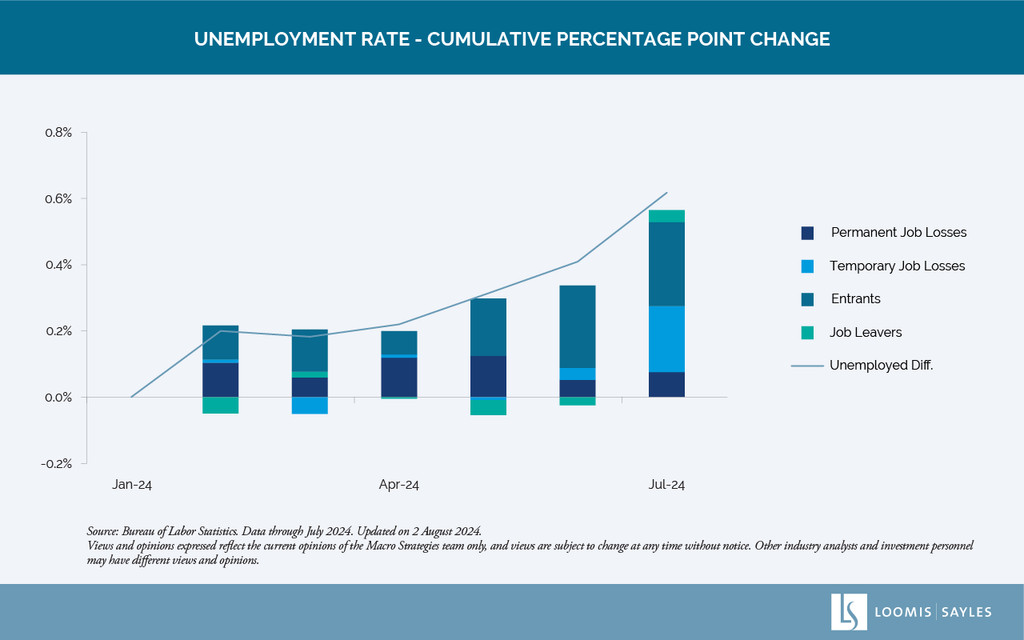
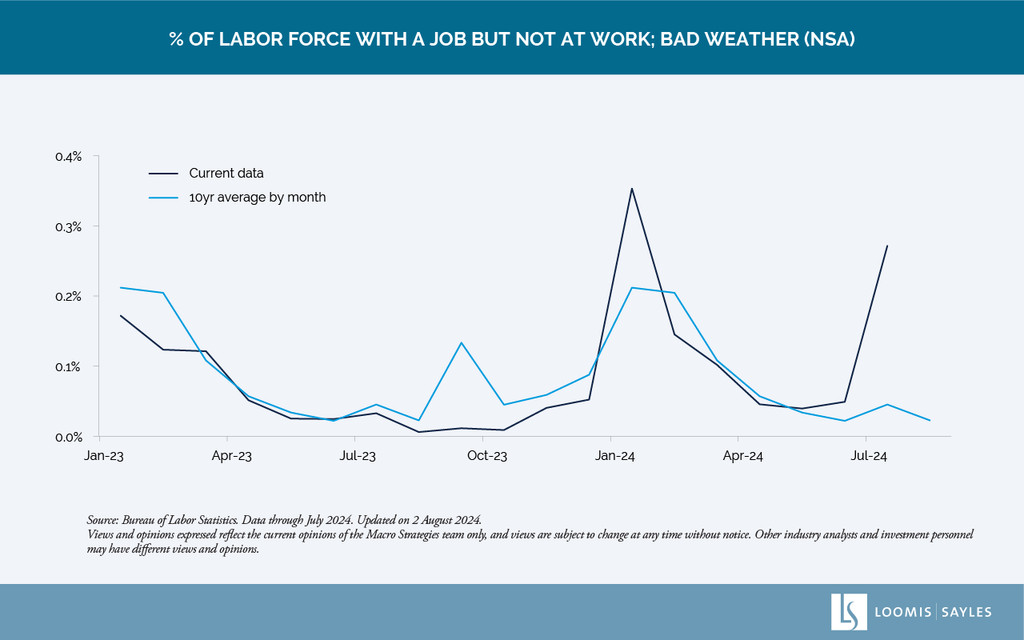
We dug into the components of the unemployment rate and found something rather comforting. Right now, temporary job losses (likely driven by Hurricane Beryl) and entrants into the workforce are responsible for the majority of the rise in the unemployment rate, rather than a significant pickup in permanent job losses.iii This indicates robust labor supply is the main driver behind the rise in the unemployment rate, which we see as a much more benign signal than if it were materially weakening labor demand.
We also found a few other encouraging signals:
- The employment to population ratio for 25-54 year olds, the primary segment of the workforce, is at a strong level and continuing to trend higher.iv
- Weekly initial unemployment claims have risen, but remain within a two-year range and far below historical recessionary levels.v
- On 1 August, Challenger, Gray & Christmas reported the lowest level of announced job cuts year to date in 2024.vi
Solid corporate health continues to underpin the economy
It’s a common refrain here – profits drive the cycle. And while our credit analysts’ outlook for corporate health has turned slightly more cautious, we expect corporate health to remain stable overall. Corporate earnings season has been strong so far, with nearly 80% of S&P 500 Index companies exceeding expectations.vii Positive earnings have been broadening out beyond the tech sector, which we see as supportive of the overall economy.
Staying alert
Volatility is typical late in the credit cycle. The Federal Reserve (Fed) is aiming for a soft landing, and softer data is supposed to be part of the package. However, we acknowledge that soft landings are historically rare and can be easy to overshoot.
This bout of volatility exemplifies how quickly market sentiment can shift. Until recently, softer data was generally perceived as “good news” for the market, as it confirmed disinflation and opened the door for Fed rate cuts. It now appears that softer data may be viewed as “bad news” for market participants as growth fears re-emerge. As for us, we’ll keep digging into the fundamentals and stay on high alert for the following:
- The August employment report. We anticipate a slower pace of job gains relative to the last couple of years, but any outright declines or severe drops in permanent employment will raise our concern.
- Any upside surprises in inflation data could roil the markets and throw anticipated Fed interest rate cuts into question. CPI (Consumer Price Index) data comes out on 14 August and PCE (Personal Consumption Expenditures) on 30 August.
- Small business sentiment. If small business owners begin tightening their belts in response to the tumult, we believe it could feed into more negative economic data.
- Will we see any weakness feed through to consumers? The recent increase in consumer delinquency rates provides reason for caution in our view, but we haven’t seen firm evidence of a consumption slowdown yet.
Endnotes
i Source: Bloomberg, as of 7 August 2024.
ii Source: Bureau of Labor Statistics, as of 2 August 2024.
iii Source: Bureau of Labor Statistics, as of 2 August 2024.
iv Source: Bureau of Labor Statistics, as of 2 August 2024.
v Source: Bureau of Labor Statistics, as of 2 August 2024.
vi Source: Challenger, Gray & Christmas, Inc. Job Cut Announcement Report, as of 1 August 2024.
vii Source: Bloomberg, as of 7 August 2024.
8352546.2.1
Market conditions are extremely fluid and change frequently.
This blog post is provided for informational purposes only and should not be construed as investment advice. Any opinions or forecasts contained herein reflect the subjective judgments and assumptions of the authors only and do not necessarily reflect the views of Loomis, Sayles & Company, L.P. Information, including that obtained from outside sources, is believed to be correct, but Loomis Sayles cannot guarantee its accuracy. This material cannot be copied, reproduced or redistributed without authorization. This information is subject to change at any time without notice.
The S&P 500® Index is a widely recognized measure of US stock market performance. It is an unmanaged index of 500 common stocks chosen for market size, liquidity, and industry group representation, among other factors. It also measures the performance of the large-cap segment of the US equities market.
Authors
